

Human growth hormone (HGH) is sometimes used in IVF treatment to improve ovarian response and egg quality, particularly in women with poor ovarian reserve or those over 40. However, while some clinics report positive outcomes, scientific evidence remains mixed, and HGH is not considered a standard IVF therapy.
Its role is supportive rather than essential, and results vary depending on individual biology.
What Is Human Growth Hormone in IVF Context?
Human growth hormone (HGH) is a naturally occurring peptide hormone that regulates growth, metabolism, and cellular repair. In fertility treatment, its use is based on the idea that it can enhance ovarian function and improve the environment in which eggs develop.
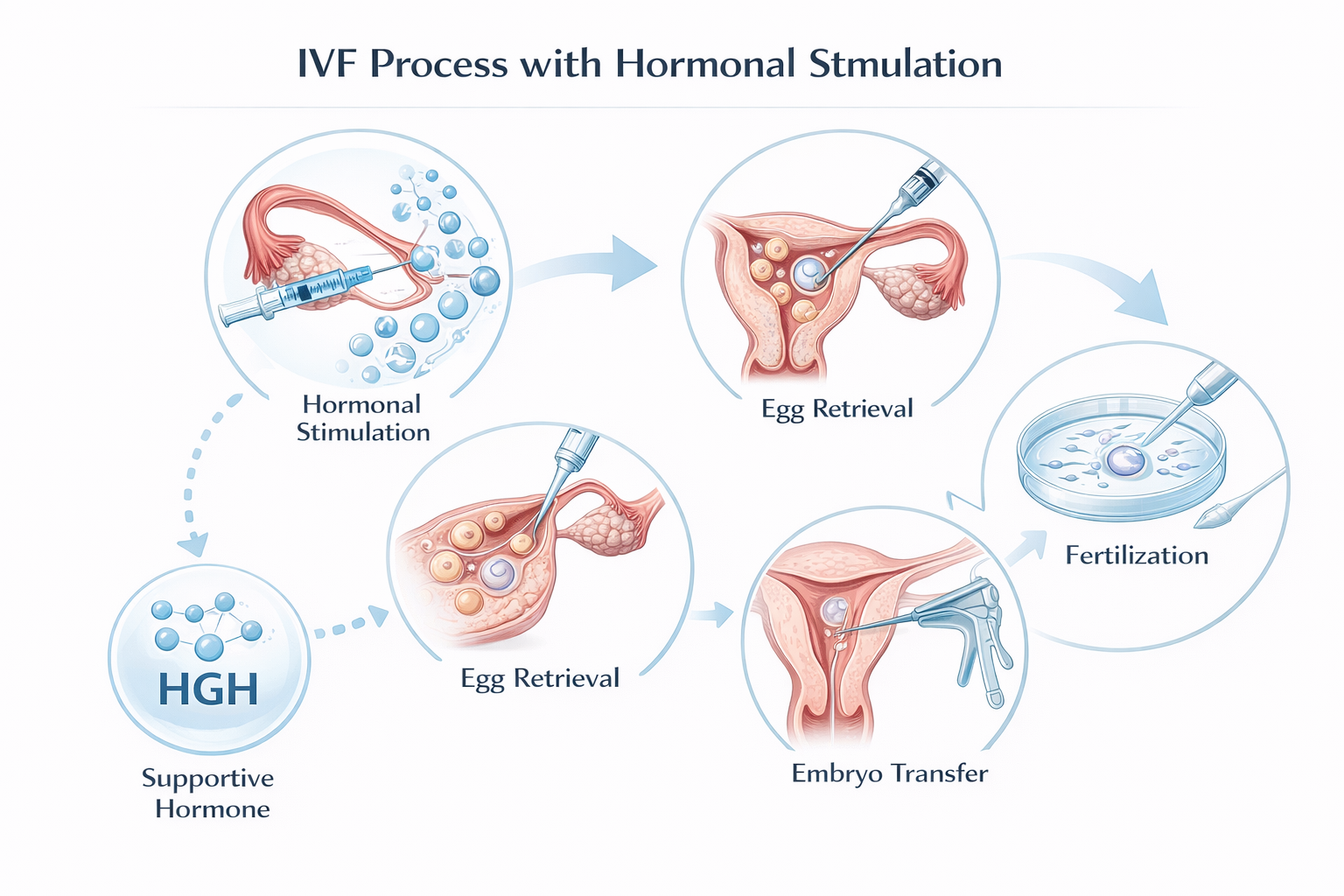
During IVF, the ovaries are stimulated using hormonal medications to produce multiple follicles. However, not all patients respond equally to stimulation. Some produce fewer eggs or eggs of lower quality, which reduces the chances of successful fertilization and implantation.
This is where HGH for IVF is sometimes introduced as an additional support therapy. It is not used to replace standard medications but to enhance their effect in specific cases.
The goal is not more eggs, but better eggs.
How HGH Works in IVF Treatment
The mechanism behind human growth hormone for IVF is linked to its interaction with insulin-like growth factor 1 (IGF-1). HGH increases IGF-1 levels, which play a role in cell growth and follicular development.
This process may improve:
- follicle sensitivity to stimulation drugs
- maturation of oocytes (eggs)
- overall ovarian response
Unlike traditional IVF medications, HGH does not directly stimulate ovulation. Instead, it modifies the internal environment of the ovaries, potentially making them more responsive.
This subtle difference is important. HGH is not a primary driver of IVF success, but it may influence supporting conditions that affect outcomes.
Better conditions may improve results.

HGH IVF Over 40: Why It Is Commonly Used
The use of human growth hormone IVF over 40 is increasing because fertility naturally declines with age. This decline is mainly due to reduced egg quality rather than just egg quantity.
Women over 40 often experience:
- diminished ovarian reserve
- lower embryo quality
- reduced implantation rates
Because of this, IVF success rates decrease significantly with age. HGH is introduced in these cases with the intention of improving egg quality and increasing the chances of viable embryos. Some clinicians believe that HGH helps older ovaries respond better to stimulation, leading to more mature eggs. However, this effect is not guaranteed and varies widely between patients. Age changes biological response.
What Does Research Say About HGH IVF?
Scientific evidence on HGH IVF is inconsistent, which is why it remains a debated topic in reproductive medicine.
According to growth hormone IVF evidence from Cochrane, HGH may improve certain intermediate outcomes such as the number of retrieved oocytes or embryo quality. However, there is no strong evidence that it significantly increases live birth rates.
This distinction is critical.
Improving egg numbers or quality does not always translate into a successful pregnancy. Many factors influence IVF success, including genetics, uterine environment, and embryo viability. Another important perspective comes from clinical discussions like growth hormone and IVF analysis from The Lucky Egg, which highlights that HGH is sometimes marketed with expectations that are not fully supported by evidence. This creates a gap between expectation and reality. Evidence remains limited.
When Is HGH Recommended in IVF?
HGH is not routinely used in all IVF cycles. It is typically reserved for specific patient groups where standard protocols have not produced optimal results.
Common situations where HGH IVF is considered include:
- poor ovarian response in previous cycles
- repeated IVF failure
- low egg quality
- advanced maternal age (especially over 40)
In these cases, fertility specialists may introduce HGH as part of a customized protocol. However, not all patients benefit equally. Some may see improvement, while others experience no noticeable difference. Individual response varies.
HGH IVF Protocol: How It Is Administered
Human growth hormone in IVF is typically given as a subcutaneous injection during the stimulation phase of the cycle.
Protocols vary between clinics, but HGH may be used:
- before ovarian stimulation begins
- during follicle development
- alongside gonadotropins
The dosage and duration depend on the patient’s condition and the clinic’s approach. There is no universally standardized protocol, which reflects the uncertainty surrounding its effectiveness. Treatment is personalized.
Potential Benefits of HGH for IVF
Although evidence is not definitive, there are several potential benefits associated with HGH use in IVF, particularly in difficult cases.
Possible advantages include:
- improved egg quality in poor responders
- increased number of mature oocytes
- better ovarian response to stimulation
These benefits are more likely to appear in women who have previously had suboptimal IVF outcomes.
However, it is important to understand that these are potential improvements, not guaranteed results.
Risks and Limitations of HGH in IVF
Despite the growing interest in HGH IVF, it is important to understand that this approach has clear limitations. One of the biggest issues is that the scientific evidence remains inconclusive, meaning that not all patients will benefit from its use.
A major concern is cost. HGH is an expensive add-on, and in many cases, it is not covered by insurance. Patients may invest significant amounts without a guaranteed improvement in outcomes.
Another limitation is variability. Some women respond positively to HGH, showing improved egg quality or ovarian response, while others experience no measurable benefit. This inconsistency makes it difficult to predict results in advance.
There are also medical considerations. Although HGH is generally considered safe under supervision, it can still lead to side effects such as fluid retention, joint discomfort, or metabolic changes.
Results are not predictable.
HGH IVF vs Other IVF Add-Ons
HGH is just one of many add-ons used in IVF treatment. Clinics often combine different supportive therapies to try to improve success rates, especially in difficult cases.
Other common IVF add-ons include:
- DHEA supplementation
- Coenzyme Q10 (CoQ10)
- platelet-rich plasma (PRP)
- immune therapies
Compared to these options, HGH is considered a more aggressive and costly intervention. While supplements like CoQ10 focus on cellular energy and mitochondrial function, HGH targets hormonal and growth pathways.
The key difference is that HGH directly influences growth signaling, while most other add-ons support cellular health indirectly.
Each approach targets a different aspect of fertility.
Who Should Consider HGH for IVF?
HGH is not suitable for every patient undergoing IVF. Its use should be based on specific clinical indicators rather than general expectation.
It may be considered in cases where:
- previous IVF cycles produced poor results
- ovarian response is consistently low
- egg quality is a known issue
- age-related decline is significant
For younger patients with normal ovarian function, HGH is usually unnecessary and unlikely to provide additional benefit.
The decision should always be individualized and guided by a fertility specialist who understands the patient’s medical history.
Not all patients need add-ons.
Who Should Avoid HGH in IVF?
There are also situations where HGH may not be appropriate or beneficial.
Patients may be advised to avoid HGH if:
- ovarian function is already normal
- there is no history of IVF failure
- the expected benefit does not justify the cost
- there are underlying health conditions that could be affected by hormone therapy
Using HGH without a clear medical reason can increase complexity without improving outcomes.
More treatment does not always mean better results.
Realistic Expectations from HGH IVF
One of the biggest issues surrounding human growth hormone IVF is unrealistic expectations. Some patients believe that HGH can significantly increase success rates or compensate for age-related fertility decline.
In reality, HGH is a supportive tool, not a breakthrough solution.
It may improve certain parameters, such as egg quality or ovarian response, but it does not eliminate the biological limitations associated with age or genetics.
IVF success depends on multiple factors, including:
- embryo quality
- uterine receptivity
- genetic integrity
HGH addresses only a small part of this complex process.
Decision Framework: Is HGH Worth It for IVF?
To better understand whether HGH IVF is worth considering, it helps to evaluate the decision based on key factors.
| Situation | Is HGH Worth Considering? |
|---|---|
| Age under 35, normal response | Usually no |
| Poor ovarian response | Possibly yes |
| Multiple failed IVF cycles | Often considered |
| IVF over 40 | Sometimes beneficial |
| Good embryo quality already | Limited value |
This table shows that HGH is most relevant in specific, challenging cases rather than standard IVF scenarios.
Practical Considerations Before Using HGH
Before starting HGH in IVF, patients should have a clear discussion with their doctor about expected benefits and limitations.
Important questions to consider include:
- What is the specific goal of adding HGH?
- What evidence supports its use in this case?
- What are the costs versus expected benefits?
- Are there alternative strategies available?
These questions help ensure that the decision is based on informed reasoning rather than hope alone.
Final Answer: Human Growth Hormone for IVF
Human growth hormone can play a supportive role in IVF, particularly for women with poor ovarian response or those undergoing IVF over 40. It may improve egg quality and ovarian sensitivity in some cases, but it does not guarantee higher pregnancy or live birth rates.
Scientific evidence remains mixed, and HGH should not be seen as a standard or essential part of IVF treatment. Its value depends on individual patient characteristics and should always be evaluated in a clinical context.
The most important factor is not whether HGH is used, but whether it is used for the right patient and the right reason.
FAQ: HGH and IVF
Does HGH improve IVF success rates?
HGH may improve certain intermediate outcomes like egg quality or ovarian response, but there is no strong evidence that it significantly increases live birth rates.
Is HGH commonly used in IVF?
No, HGH is typically used only in specific cases such as poor responders or patients with previous failed IVF cycles.
Does HGH help IVF over 40?
It may help improve egg quality in some women over 40, but results are inconsistent and not guaranteed.
How is HGH used in IVF treatment?
HGH is usually administered as an injection during the ovarian stimulation phase, alongside standard IVF medications.
Is HGH safe during IVF?
HGH is generally considered safe under medical supervision, but it can still have side effects and should only be used when clinically appropriate.